
On view
Vivre Sa Vie
Rita Ackermann
17 October to 28 November 2026
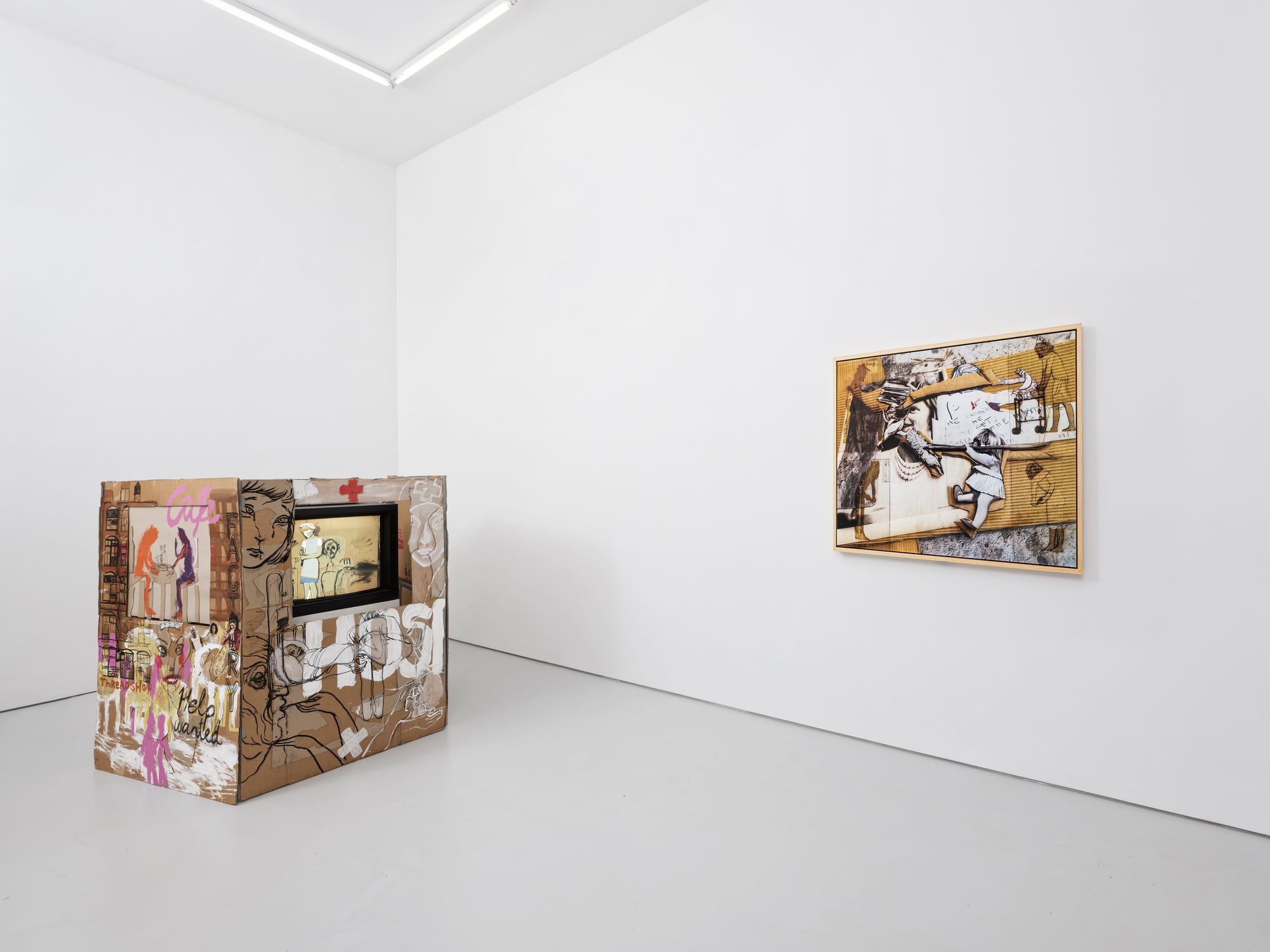
Galerie Allen is pleased to present an exhibition centred on a seminal, once-performed multimedia project by Rita Ackermann, first realised in 1996. Vivre sa Vie was conceived as a live puppet performance engaging underground music, experimental cinema, and fashion, in collaboration with key figures of the 1990s Downtown New York scene.
Originally produced in the context of a musical release on Ecstatic Peace!, the label run by Sonic Youth co-founder Thurston Moore, the project emerged from a challenging invitation. Moore first encountered Ackermann while she was painting the windows of the New Museum on Broadway; their exchange soon expanded into collaborations for the cover of Thurston's solo album, Psychic Hearts and Ackermann's solo record release titled Slave Songs (Sunny Expends), now held in MoMA's Department of Drawings and Prints.
Invited to take part in a listening event alongside prominent musicians from the 1990s New York avant-garde scene, Ackermann chose instead to stage an immersive puppet show inspired by Jean-Luc Godard's Vivre sa vie, a film she regards as foundational to her practice, and thus a fertile source to explore.
While bearing the title of Godard's 1962 film, the puppet show does not retell the original narrative. Instead, it offers a parallel emotional and ethical portrait: a young woman whose relentless search for purpose in life is defined by radical generosity, boredom, and exhaustion, someone who gives relentlessly (care, attention, labor, intimacy) until depleted. Darkly humorous and deeply unsettling, the work presses on themes of devotion, desire, self-erasure, and the quiet violence embedded in care. Ackermann's longstanding engagement with cinema, particularly the stylised immediacy of the French New Wave, inflects both the rhythm and structure of the piece.
The original presentation was profoundly collaborative, and fused figures emblematic of the era's porous boundaries between art, music, and fashion. The story was narrated by musician Kim Gordon (Sonic Youth, Free Kitten, Body/Head), while sound was performed by members of the legendary No-Neck Blues band. The puppets' costumes were created in miniature by Susan Cianciolo, whose RUN project (1995-2001) became an influential model of anti-commercial, handcrafted fashion-as-art rooted in community and performance, long before the term "upcycling" became ubiquitous.
Aesthetically, the project is marked by an economy of means and a rigorous attention to construction. The puppets and stage sets are fully articulated front and back, revealing annotations, mechanisms, and positional markings used to animate each scene. This insistence on double-sided legibility, image and function, illusion and labor, remains central to Ackermann's practice, exposing the infrastructure behind representation.
For this exhibition, the work is presented through a newly conceived sculptural display. A hexagonal stage structure occupies the center of the gallery, allowing viewers to encounter multiple façades and interior scenes simultaneously. At its core, a video monitor screens archival footage of the original 1996 performance, anchoring the installation in its historical moment while activating it in the present. The puppets themselves are framed and mounted in ways that reveal both front and reverse, inviting viewers to look behind the scene and into the mechanics of animation.
Lastly, Ackermann produced a new work that returns to collage, a central element of her practice. Over the past year, she developed a wall-based piece that was three-dimensionally scanned and sculpted from a two-dimensional collage. This relief, born from a 3D translation of the original collage, revisits recurring motifs within the artist's visual vocabulary, connecting different chapters of her practice and bringing their underlying threads into focus. It suggests how each period contains traces of the others, as time moves linearly through the artist's oeuvre while continually folding back on itself.
Born in Budapest in 1968, Ackermann moved to New York in the early 1990s, where her work became associated with the city's cultural intensity, at once graphic, bodily, and charged with the psychic textures of youth culture. Across the decades, her practice has moved fluidly between figuration and abstraction through drawing, painting, printmaking, music, and video. Erasure, fragmentation, and reconstruction allow images to reappear as unstable traces. This expanded project belongs to that broader trajectory: a work that treats narrative and performance as surfaces to be built, handled, revised and exposed, inviting viewers to explore the relationship between image and sound.
The exhibition is accompanied by a limited-edition artist book featuring expanded materials. Additional related works, drawings, collages, and prints, extend the project's visual language and situate it within the broader arc of Ackermann's practice. Together, these elements offer a rare opportunity to revisit a pivotal yet underexposed work, one that crystallises a specific cultural moment while continuing to resonate through its tenderness, discomfort, and uncompromising generosity.
Installation views